


HARPO
The first new window is related to an energy range in which astrophysicists are effectively “blind”. The electromagnetic spectrum has been studied in great detail from the low frequency radio band all the way up to the very-high-energy (multi-TeV) gamma-ray regime but, if we plot the sensitivity of these observations as a function of energy, there remains one large hole. This is located in the MeV energy range, between 0.1 and 100 MeV, the so-called “MeV Gap”. It is clearly visible in this study of blazars [1],
a subclass of active galactic nuclei who emit across the entire electromagnetic spectrum, where their energy distribution is plotted as a function of energy. Were we able to access this energy range, it would enable us to explore the formation of supermassive black holes via the study of MeV blazars [2]
, to study gamma-ray bursts who have the peak of their emission at these energies <a href="https://indico.in2p3.fr/event/14279/contributions/17566/attachments/14551/17826/nava_MeV_pol.pdf
“>[3], [4], to search for signatures of MeV dark matter [5] as well as investigating many other important astrophysical objects, such as pulsars, supernova remnants and binary systems whose emission in this region of the spectrum remains unexplored [6].
The second new window concerns polarimetry. If we look at the energies for which we have polarisation measurements, the situation is even more challenging than that of the energy coverage. At the present time, we only have sensitive polarisation information up to the keV energy regime. Polarisation allows us to access information that tells us about the physical structure and characteristics of the emitting object – information that is difficult (even impossible) to otherwise obtain for cosmic sources. Since many astrophysical objects have a lot of their power in the MeV energy regime (gamma-ray bursts, blazars, pulsars to name but a few), an instrument with sensitivity and the ability to perform polarimetry at these energies could help us to answer many big questions about our universe: How do supermassive black holes form? What class of object is responsible for the acceleration of the cosmic rays to the highest energies? Is Lorentz invariance violated?
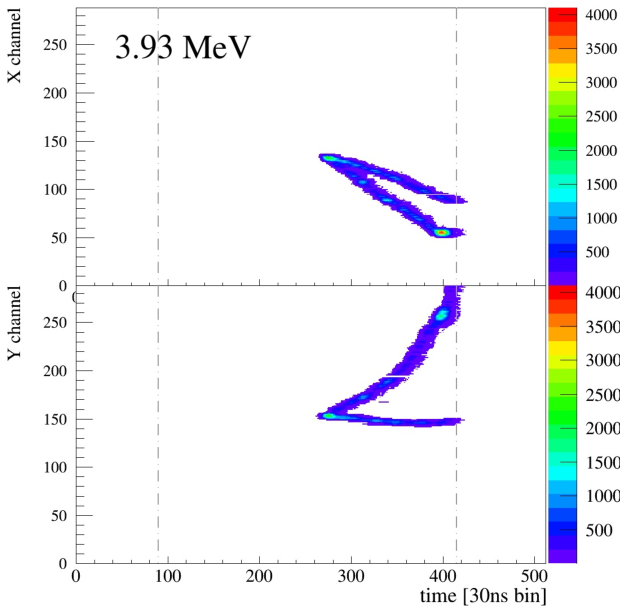
To perform polarimetry at MeV energies, a high angular sensitivity at these energies is required – a goal that has escaped scientists up until now. Researchers at Laboratoire Leprince Ringuet (LLR) have developed a novel way of accessing the information that MeV photons carry with them by using a time projection chamber (TPC), the once-preferred instrument of high-energy physicists, to capture the first interaction of these cosmic MeV photons. The TPC allows for the accurate characterisation of the pair-conversion of the incident gamma ray so that its arrival direction can be deduced very precisely thus allowing information on their polarisation vector to be measured prior to the onset of multiple scattering whereby all such information is diluted.

