


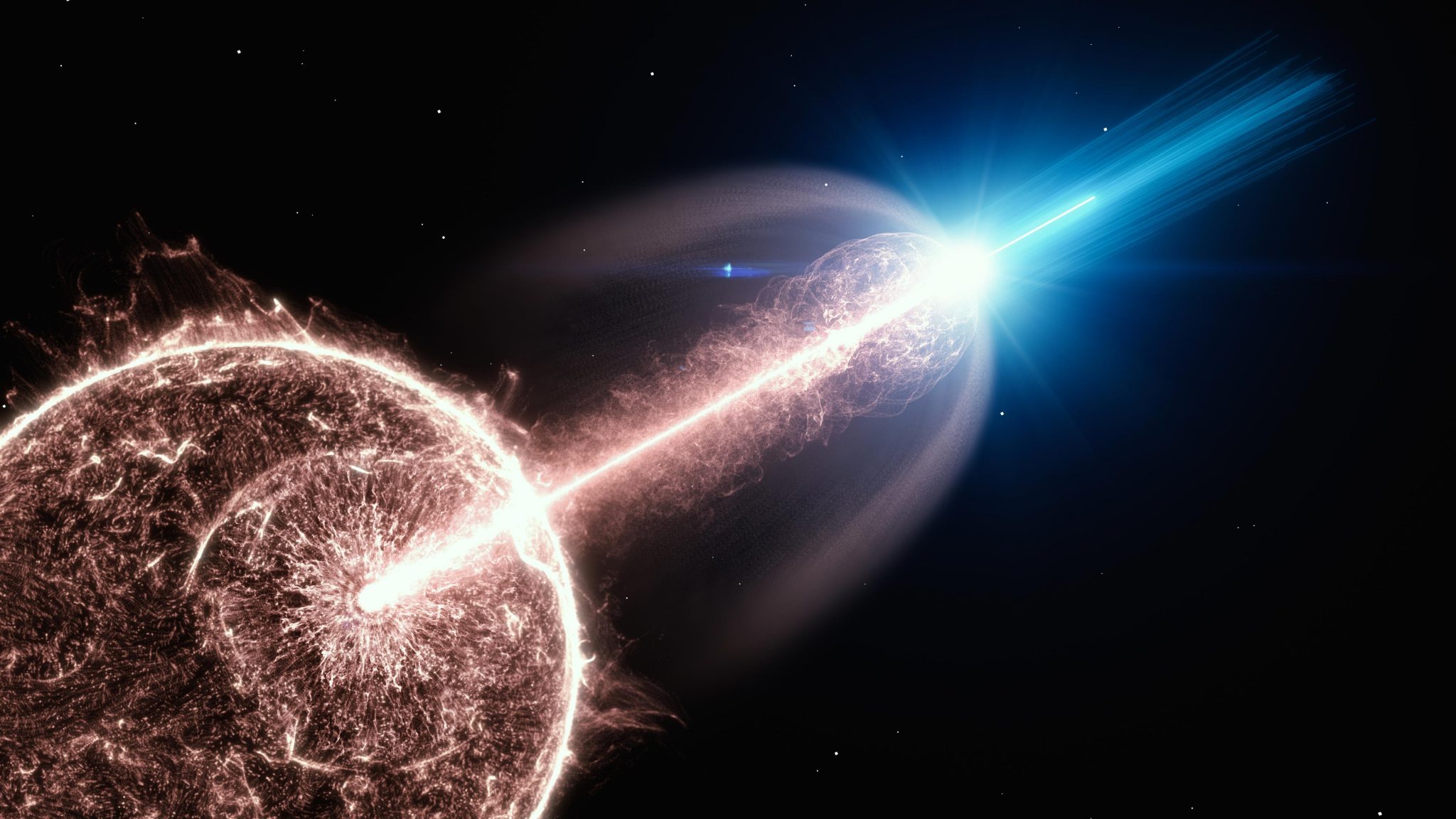
An exceptional cosmic explosion
On August 29, 2019, the satellites Fermi and Swift detected a gamma-ray burst in the constellation of Eridanus. The event, cataloged as GRB 190829A, according to its date of occurence, turned out to be one of the nearest gamma-ray bursts observed so far, with a distance of about one billion lightyears.}} For comparison, the typical gamma-ray burst is about 20 billion lightyears away. The afterglow of the explosion was captured as soon as it became visible by the H.E.S.S. telescopes (High Energy Stereoscopic System) in Namibia.
The comparatively short distance to this gamma-ray burst allowed detailed measurements of the afterglow’s spectrum, which is the distribution of “colors” or photon energies of the radiation, in the very-high energy range.
GRB 190829A’s spectrum was determined up to an energy of 3.3 tera-electronvolts, that’s about a trillion times as energetic as the photons of visible light. This is the highest energy of a gamma-ray burst recorded to date.
 Artist’s impression of very-high-energy photons from a gamma-ray burst entering Earths’ atmosphere and initiating air showers that are being recorded by the telescopes of the High Energy Stereoscopic System (H.E.S.S.) in Namibia. Credit: DESY, Science Communication Lab
As GRB 190829A occurred in our cosmic backyard, its very high energy photons were not absorbed by collisions with background light on their way to Earth, as occurs on larger distances.
The result was surprising: the observations revealed curious similarities between X-ray and very high-energy gamma-ray emissions from the afterglow of the explosion. Contrary to established theories which assume that the two components of the emission must be produced by separate mechanisms, observations of the afterglow of GRB 190829A show that the X-rays and gamma rays have decreased synchronously.
In addition, the energy spectrum of gamma rays clearly corresponds to an extrapolation of the X-ray spectrum. These results indicate that the X-rays and the very high energy gamma rays of this afterglow were produced by the same mechanism and at the same time.
“The scope of this possibility underlines the need to continue studies on the afterglow emission of very high energy gamma-ray bursts”, notes Mathieu de Naurois, deputy director of H.E.S.S. and researcher at LLR.
GRB 190829A is only the fourth gamma-ray burst detected from the ground. However, the previously detected explosions occurred much further into the Cosmos and their afterglow could only be observed for a few hours each and not at energies greater than 1 tera-electronvolt.
The prospects for detecting gamma-ray bursts by next-generation instruments look promising: Scientists expect regular detections in the very high-energy band to become common with improved instruments, which will help to fully understand these cosmic explosions. gargantuan.
contact : [Mathieu de Naurois